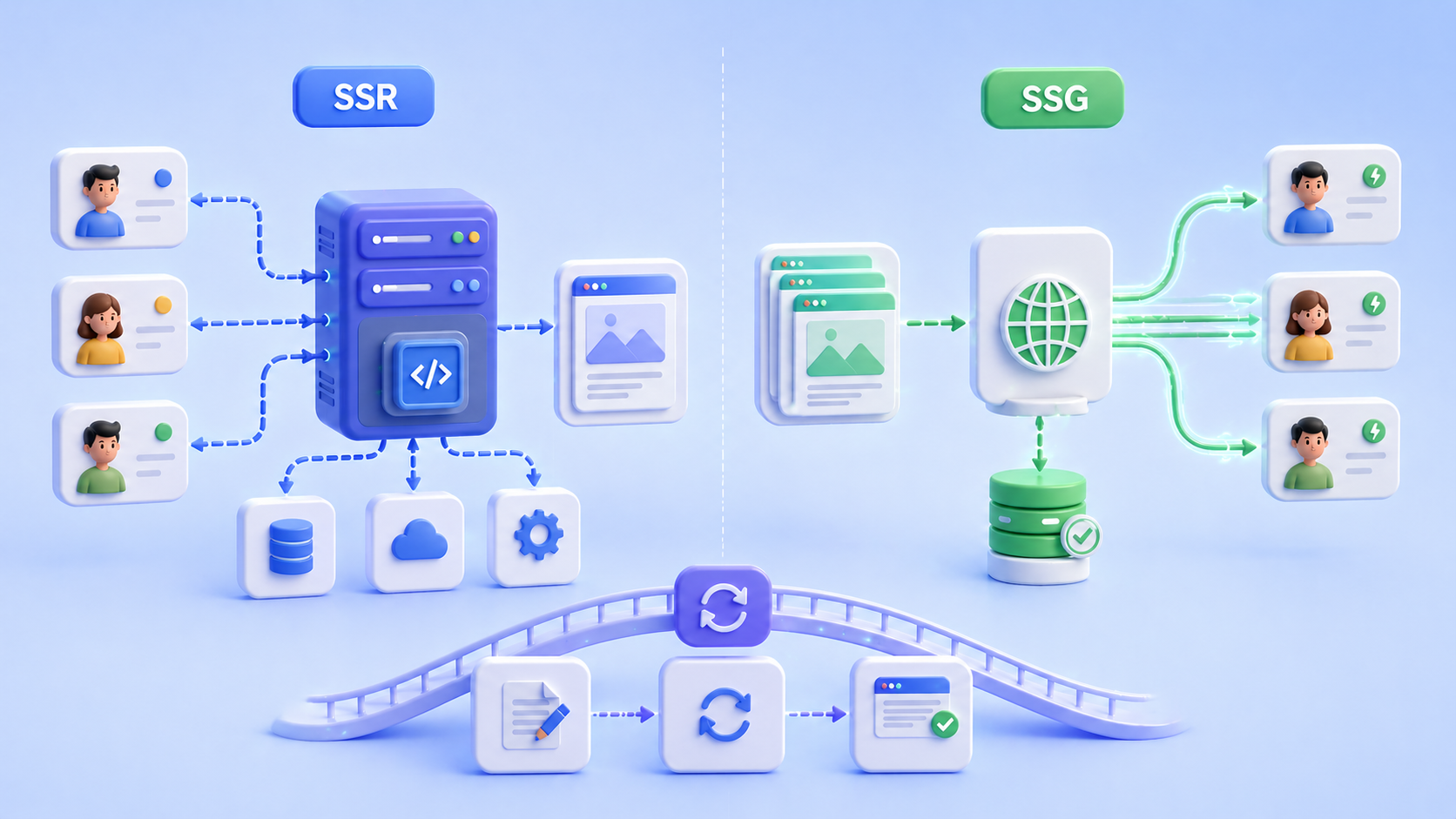
SSR vs SSG in Next.js: Differences, Advantages, Disadvantages, and Real‑World Use Cases
A Practical Architecture Guide to Choosing Between Server-Side Rendering, Static Site Generation, and Incremental Static Regeneration in Modern Next.js Applications

Introduction
Next.js is not just a React framework. It is an opinionated architecture layer that gives developers multiple rendering strategies to solve different business problems.
Among all its features, two rendering methods often create confusion:
- Server-Side Rendering (SSR)
- Static Site Generation (SSG)
And when performance meets dynamic updates, Incremental Static Regeneration (ISR) enters the picture.
This guide explains:
- What SSR and SSG actually mean
- How they work internally
- Their advantages and disadvantages
- When to use which approach
- How ISR bridges the gap
Let’s break it down clearly.
Understanding the Core Rendering Strategies in Next.js
Next.js supports multiple rendering models:
- Client-Side Rendering (CSR)
- Server-Side Rendering (SSR)
- Static Site Generation (SSG)
- Incremental Static Regeneration (ISR)
Each one exists for a reason. Choosing the wrong one does not just affect performance — it affects cost, scalability, SEO, and long-term maintainability.
In this article, we focus on SSR and SSG, because this is where most architectural decisions are made.
Server-Side Rendering (SSR)
Server-Side Rendering means that the HTML of the page is generated on every request.
When a user visits a page : Every request creates a new page.
How SSR Works
- 1The request goes to the server.
- 2The server fetches required data (from APIs).
- 3The server generates fresh HTML.
- 4That HTML is sent back to the browser.
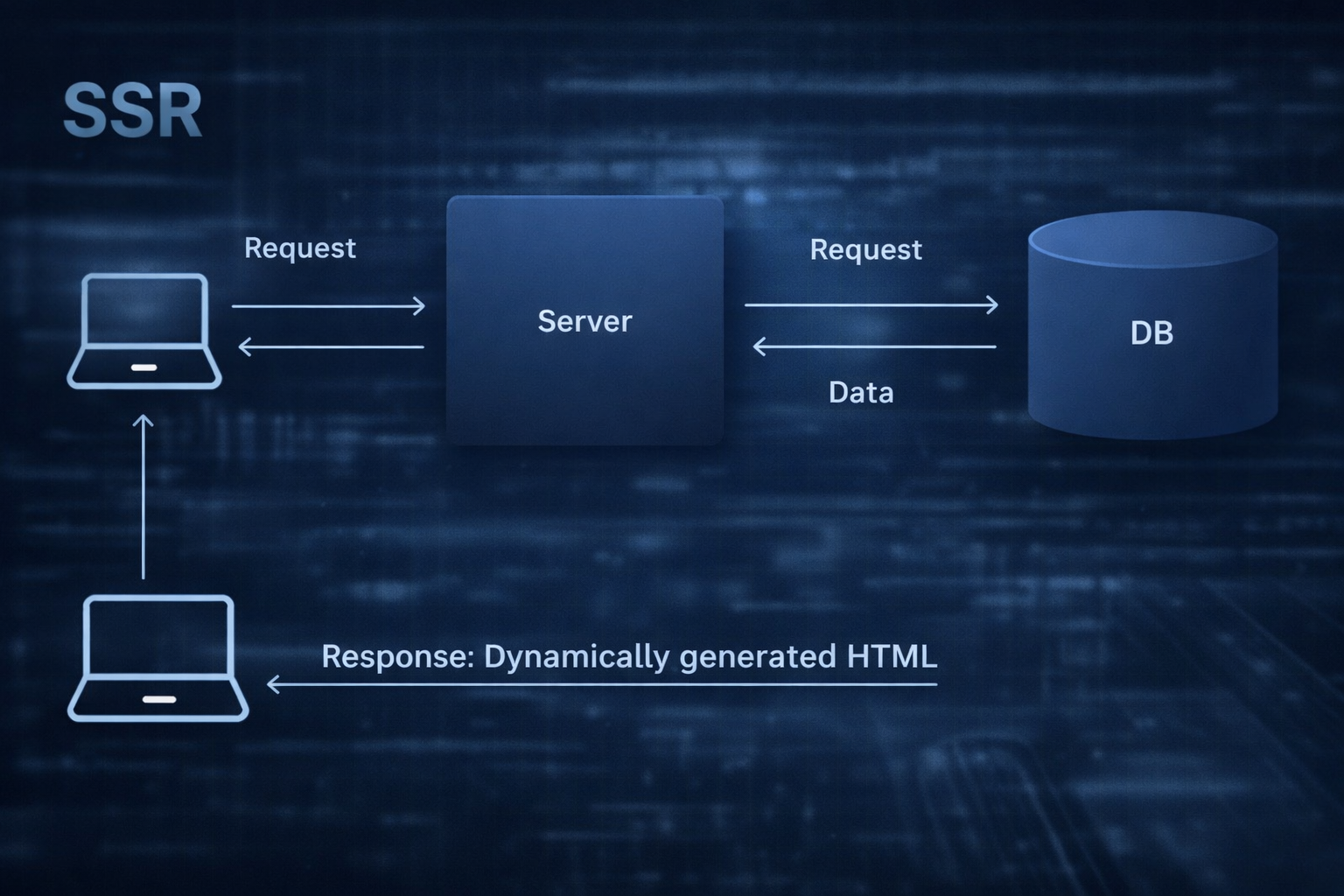
This happens for every user, every time.
Where SSR Is Commonly Used
SSR is widely used in SaaS and enterprise-grade applications where data changes frequently.
Examples :
- Real-time dashboards
- Chat applications
- Insurance portals
- Banking systems
- E-commerce product stock pages
If the data must always be current at the moment of request, SSR becomes a strong candidate.
Advantages of SSR
- Fresh data on every request ensures users always see the most up-to-date content.
- Strong SEO support allows search engines to easily crawl and index fully rendered HTML from the server.
- Ability to handle complex logic enables secure database connections, private API access, authentication, and server-side computations.
Disadvantages of SSR
- Higher server load occurs because every request requires fresh data fetching and HTML generation.
- Increased infrastructure cost results from the additional server-side computation needed for each request.
- Slower response under heavy traffic can happen when high request volumes strain the server without proper optimization.
When to Use SSR
Use SSR when:
- Data changes frequently
- Each user sees personalized content
- You need authentication-based rendering
- Real-time correctness matters more than speed
Avoid SSR when content rarely changes and traffic is very high. In those cases, SSR may become unnecessarily expensive.
Static Site Generation (SSG)
Static Site Generation means that HTML pages are generated at build time, not at request time.
During deployment:
- 1Next.js calls APIs.
- 2It fetches required data.
- 3It generates static HTML files.
- 4These files are stored on a CDN.
When users visit the page, they receive pre-built HTML instantly.
How SSG Works
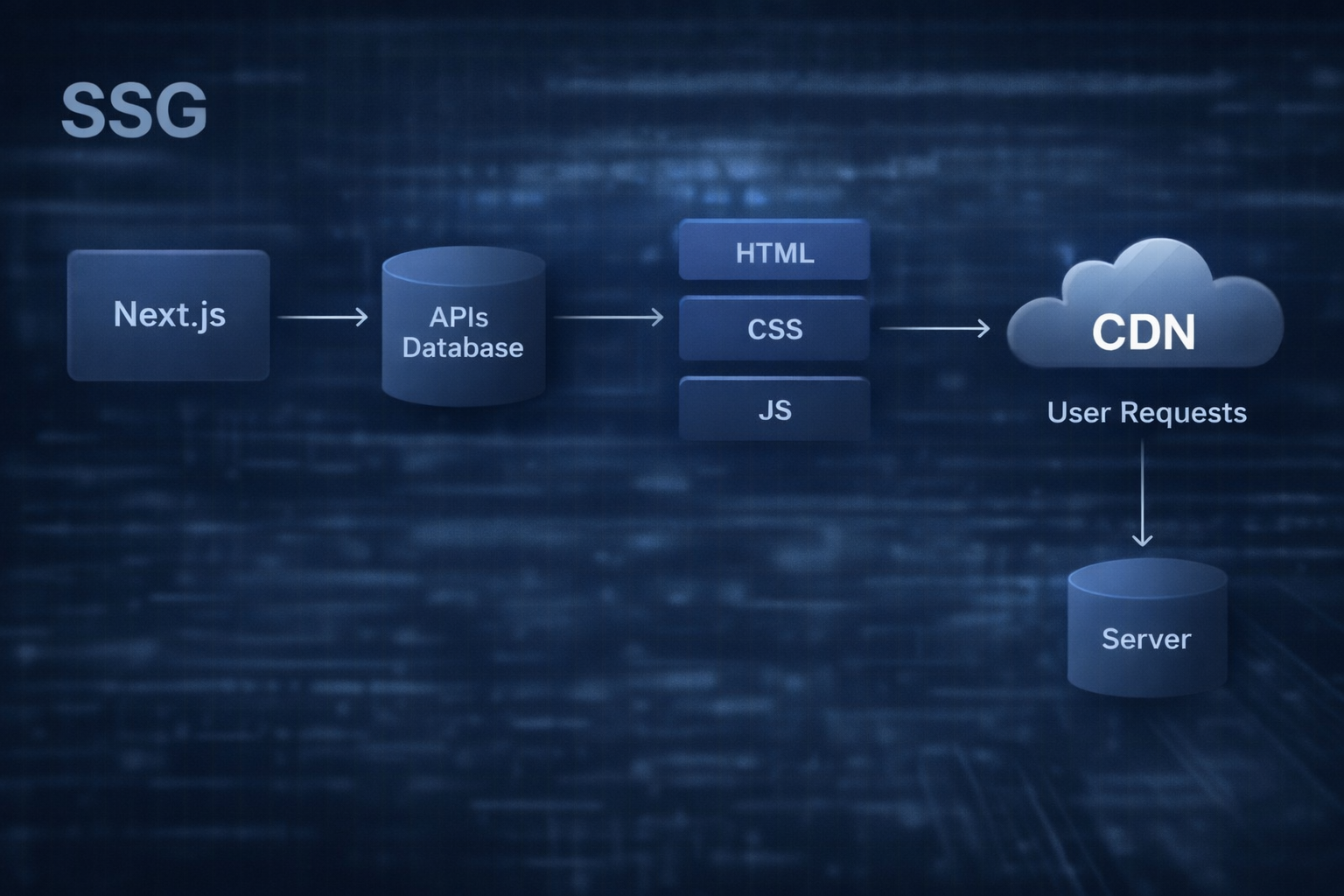
No server-side computation happens per request.
Example: Blog System
If you have 100 blog posts, the build process generates 100 static HTML files:
- /blog/post-1
- /blog/post-2
- /blog/post-3
Each page is ready before the user ever visits.
Where SSG Is Commonly Used
- Blogs Site
- Documentation sites
- Marketing pages
- Company websites
Advantages of SSG
- Extremely fast loading is achieved because pages are prebuilt and served directly from a CDN.
- Excellent SEO is supported since the content is already rendered into static HTML.
- Low server cost is possible because no computation is required on each request.
Disadvantages of SSG
- Content is not real-time because pages must be rebuilt and redeployed to reflect new data changes.
- Build time can become very long when generating a large number of static pages.
- Not ideal for highly dynamic or personalized content that requires user-specific data on each request.
When to Use SSG
Use SSG when:
- Content rarely changes
- SEO is important
- Traffic is high
- Personalization is not required
"The Real Question: What If Content Changes ?"
If you use SSG and publish a new blog, do you need a full rebuild?
Traditionally, yes.
But Next.js introduced Incremental Static Regeneration (ISR) to solve this limitation.
Incremental Static Regeneration (ISR)
ISR allows you to update static pages without rebuilding the entire site.
There are two types of ISR:
- 1Time-Based ISR
- 2On-Demand ISR
1. Time-Based ISR
You define a revalidation time (for example, 1 day).
After the time expires:
- The next visitor triggers regeneration.
- The old page is shown immediately.
- A fresh version is generated in the background.
- The cache updates automatically.
2. On-Demand ISR
In this approach:
- Your backend triggers a webhook.
- The webhook tells Next.js which page changed.
- Only that page is regenerated.
- No full rebuild happens.
This is extremely powerful for blog systems and CMS platforms.
SSR vs SSG: Direct Comparison
| Feature | SSR | SSG |
|---|---|---|
| Data Freshness | Always fresh | Fresh only at build time |
| Performance | Depends on server load | Extremely fast via CDN |
| Cost | Higher infrastructure cost | Lower cost |
| Personalization | Excellent | Limited |
| Scalability | Requires scaling servers | Scales easily with CDN |
So Which One Should You Choose?
There is no universal winner.
Choose SSR if:
- Data must always be current
- Users see personalized content
- Business logic runs per request
Choose SSG if:
- Content is mostly static
- Performance and cost efficiency matter
- SEO is important
Choose SSG + ISR if:
- Content updates occasionally
- You want performance with flexibility
- You are building a CMS-driven blog
Final Thoughts
Rendering strategy is not just a technical decision. It is a product decision.
- SSR gives control and freshness.
- SSG gives speed and scalability.
- ISR gives balance.
Before choosing, ask:
- How often does my data change?
- Does each user see different content?
- Is performance more important than real-time updates?
- What is my infrastructure budget?
When you answer these honestly, the right rendering strategy becomes obvious.
In modern Next.js applications, the smartest architecture is often a mix — using SSR where necessary, SSG where possible, and ISR where practical.
That balance is what separates a working application from a scalable one.
Featured Posts

What Is a CMS and Does Your Business Actually Need One?
Learn what a CMS is, how it helps teams manage website content, and how to decide if your business needs one based on content volume, workflows, SEO goals, and growth plans.

Best CMS for Small Business Websites in 2026
Find the best CMS for small business websites in 2026. Compare what matters for SEO, content, lead generation, and scalability so you can choose a platform that supports real growth, not just publishing.

CMS vs Static Website and What Growing Service Businesses Should Choose
Compare CMS vs static websites for growing service businesses. Learn when a simple site is enough, when it limits SEO and leads, and how to choose the right setup for long-term growth.